Recently, I’ve been hearing a sentence again and again, in the therapy room, among friends, and even within my own family:
“I think I’m the black sheep.”
It’s being said with pain, with confusion, sometimes even with quiet pride.
And it raises an important question, especially in intense times like these:
Is this something new… or has it always been there, just easier to ignore before?
What does “the black sheep” actually mean?
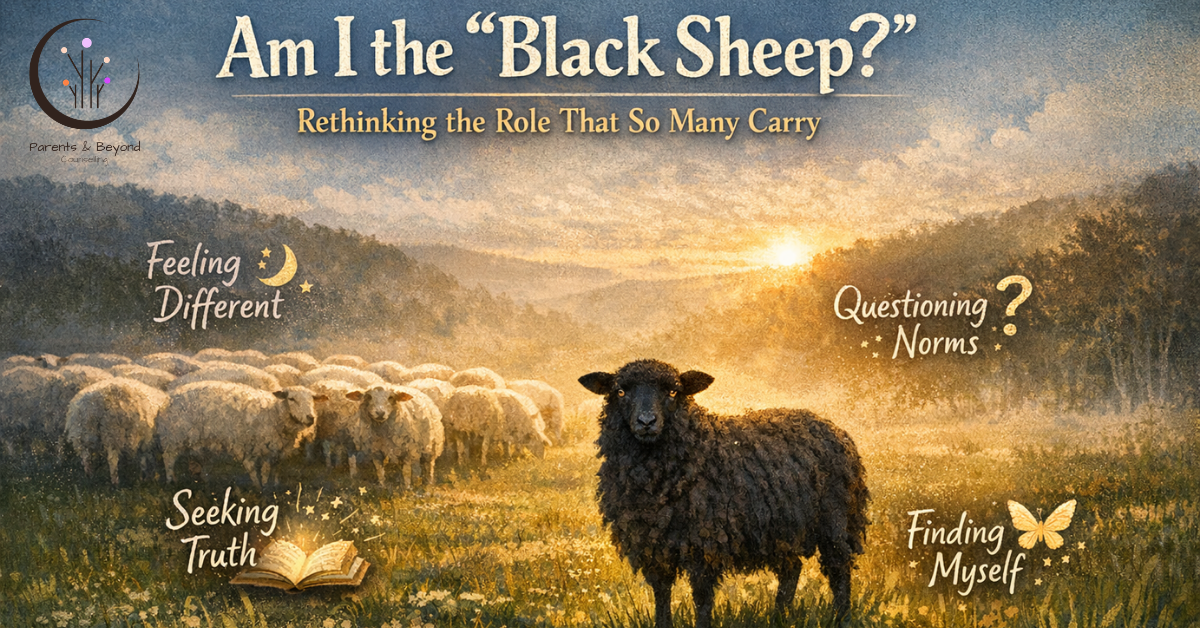
Traditionally, the “black sheep” is the one who doesn’t fit.
The one who challenges, questions, feels differently, or lives differently.
In families, this role is rarely random.
It often belongs to the person who:
- Sees what others avoid
- Speaks what others keep silent
- Feels deeply in systems that may not know how to hold emotion
- Refuses, consciously or not, to follow unspoken rules
In many ways, the “black sheep” is not outside the system…
But actually deeply connected to it, just in a different way.
Do we choose to be the black sheep?
Not really.
This role tends to emerge through a subtle interaction between:
- A child’s temperament (sensitive, intuitive, independent)
- The family’s values, expectations, and emotional capacity
- The unspoken “rules” of belonging in that family
Over time, a dynamic forms.
If being yourself leads to tension, disapproval, or misunderstanding, you may begin to internalize:
“Something about me is too much… or not enough.”
And that’s often where the identity of “black sheep” begins.
Is it real, or is it our interpretation?
This is where it gets nuanced.
Sometimes, there is a real difference in how someone is treated.
Other times, it’s a deeply felt interpretation shaped by:
- Past experiences
- Attachment wounds
- Sensitivity to rejection
- Repeated subtle dynamics
Both can be true at the same time.
The feeling is real, even when the story around it needs gentle unpacking.
Does being the black sheep have any benefits?
Surprisingly, yes!
Many “black sheep” individuals develop:
- Strong self-awareness
- Emotional depth and empathy
- Independent thinking
- Courage to question and grow
- Authenticity over conformity
They often become the ones who:
- Break generational patterns
- Seek therapy, healing, and change
- Create new ways of relating, for themselves and for others
What once felt like “not belonging”
can become a powerful source of identity and purpose.
How do our parents’ beliefs and upbringing play a role?
Families don’t exist in a vacuum.
Parents bring with them:
- Their own childhood wounds
- Cultural expectations
- Beliefs about success, emotions, and roles
- What was “allowed” or “forbidden” in their own upbringing
If a child expresses something outside of that framework, it can feel threatening or unfamiliar to the system.
Not because the child is wrong…
But because the system doesn’t yet have the capacity to hold that difference.
Does it mean they don’t love us?
This is often the most painful question.
And the answer is complex.
In most cases, it’s not a lack of love.
It’s a limitation in how love is expressed.
Love can exist alongside:
- Misunderstanding
- Emotional immaturity
- Inability to validate differences
- Fear of what feels unfamiliar
For the person who feels like the black sheep,
this can feel like rejection.
But often, it is not absence of love, it is a mismatch in emotional language.
Can we interpret it differently?
Yes, and this is where healing begins.
Instead of asking:
“What’s wrong with me?”
We begin to ask:
- What role did I take on in my family?
- What did it protect me from?
- What strengths did it give me?
- What beliefs am I still carrying that may not be mine?
Being the “black sheep” can shift from:
👉 A story of exclusion
to
👉 A story of differentiation
From:
👉 “I don’t belong”
to
👉 “I am different, and that has value.”
A reflection
If you’ve ever felt like the black sheep…
Maybe you were never meant to fit into a system
that couldn’t fully see you.
Maybe your role wasn’t to blend in, but to expand what’s possible in your family.
And maybe, just maybe…
What felt like disconnection
is actually the beginning of a deeper, more authentic belonging first with yourself!